Which Jobs Are Most at Risk From AI — and Which Are Growing Because of It
AI is changing the job market unevenly. Some routine roles are under pressure, while demand is growing for AI-related work, skilled trades, healthcare, and roles built around judgment and accountability.
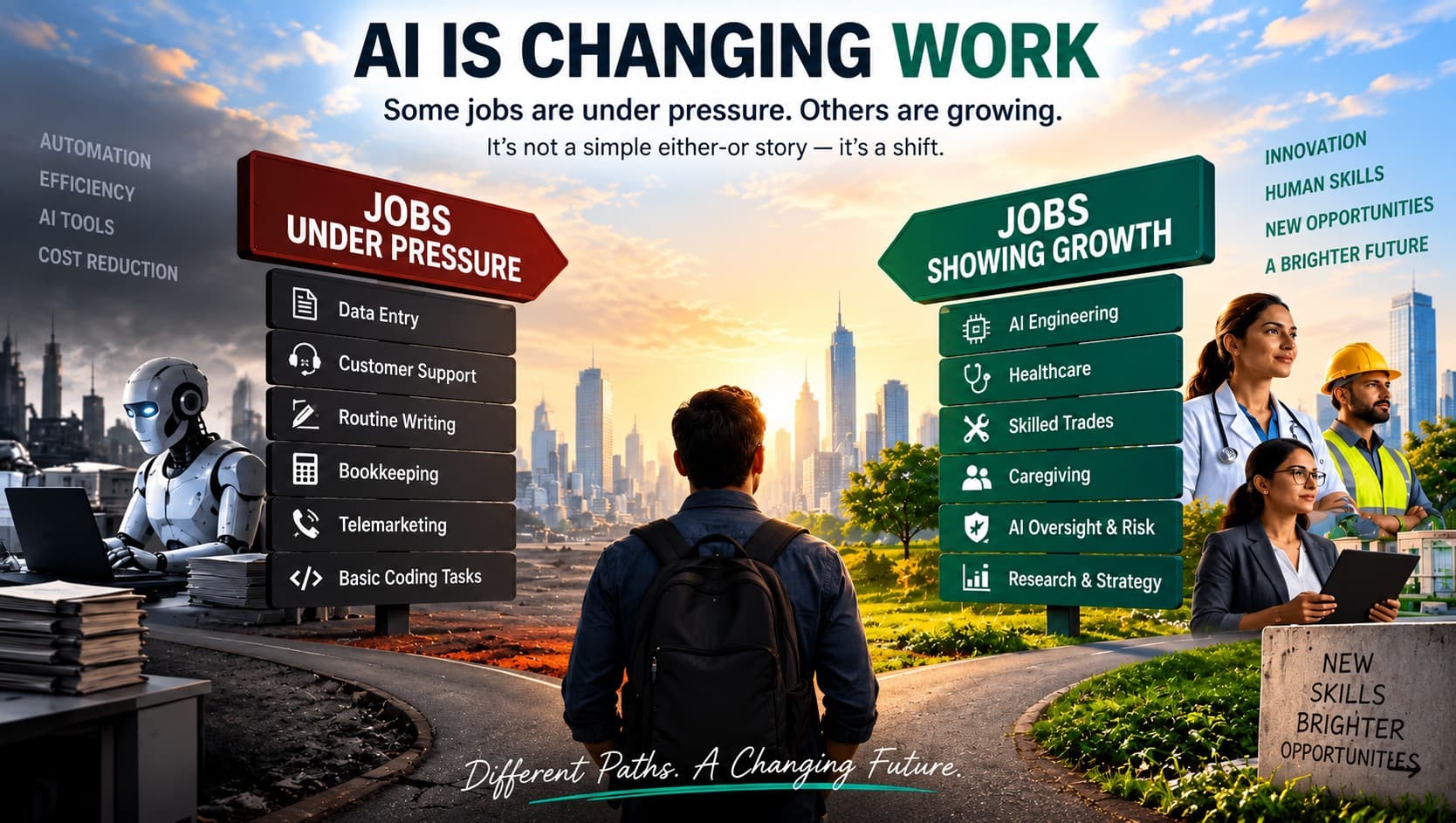
AI is changing the job market, but not in the simple way headlines often suggest. Some stories focus on jobs disappearing. Others point to companies hiring specifically for AI-related roles. Both are happening at the same time.
The more useful question isn't whether AI will destroy jobs or create them. It's which kinds of work are becoming easier to automate, which roles are growing, and which jobs are changing shape because AI is becoming part of the workflow.
This article looks at the actual patterns behind that shift — without the doom or the hype. We'll look at where work is shrinking, where demand is growing, and what that might mean for the skills people build next.
The Big Picture Number Worth Knowing First
The World Economic Forum's Future of Jobs Report 2025 gives a useful starting point. Based on a survey of more than 1,000 employers representing more than 14 million workers, the report projects that by 2030, 92 million existing jobs could be displaced by major labour-market shifts, while 170 million new roles could be created.
That would mean a net increase of around 78 million jobs globally. But the important part is not the headline number. The bigger story is that the types of work employers need are changing at the same time.
So the picture isn't simply jobs disappearing. It is a combination of roles being reduced, new roles being created, and existing jobs being redesigned around new technology.
What's Actually Shrinking
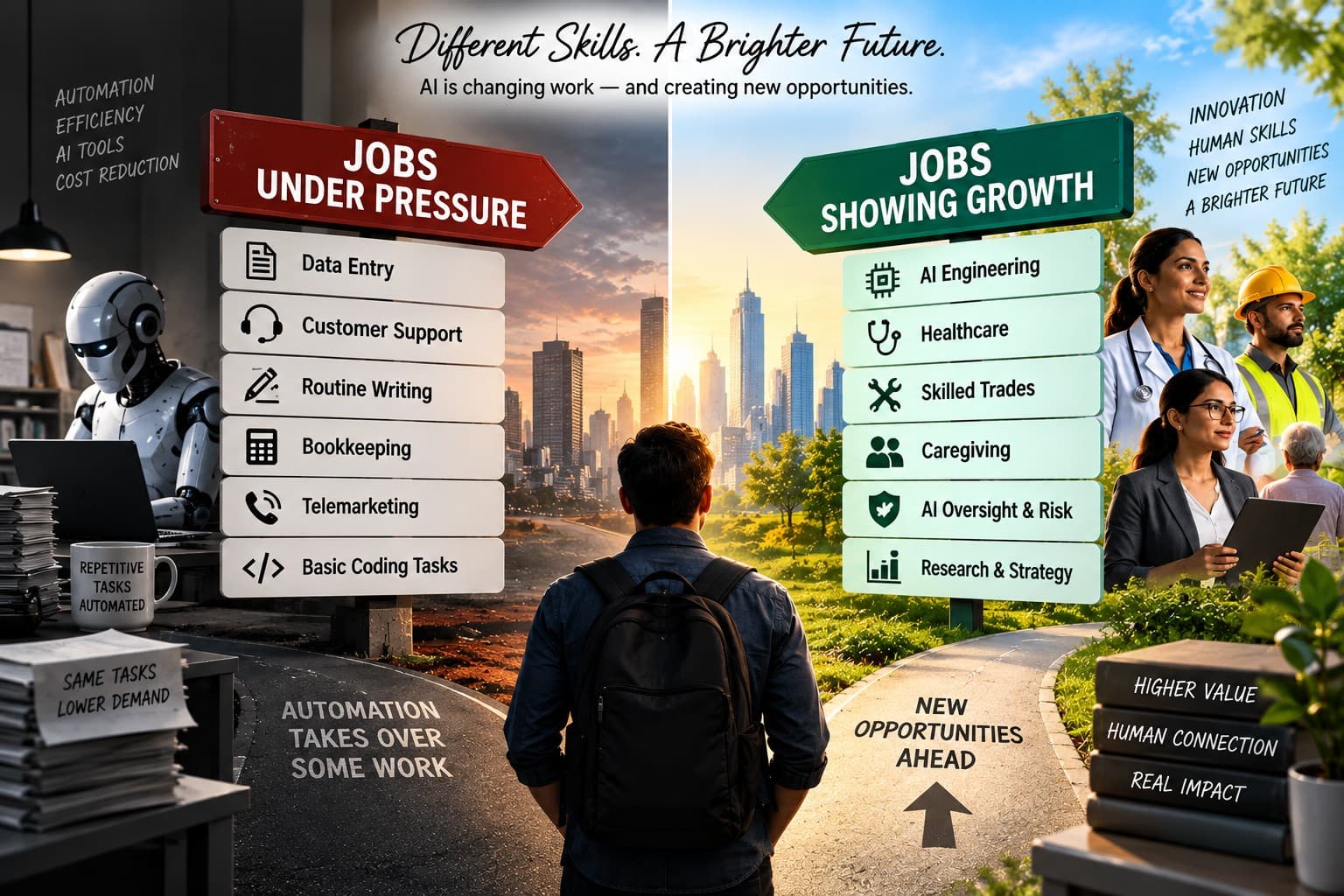
The work facing the most pressure tends to share a few characteristics: it is routine, predictable, digital, and relatively easy to describe as a repeatable process. The World Economic Forum's 2025 analysis identifies clerical and secretarial roles among the job categories expected to see some of the largest declines by 2030.
Examples of work facing pressure include data entry, routine clerical tasks, bookkeeping support, telemarketing, and other structured digital workflows. Microsoft Research found that generative AI is most applicable to knowledge-work groups such as computer and mathematical occupations, office and administrative support, and sales, particularly for activities involving writing, information gathering, and communication.
Source: Microsoft Research — Working with AI: Measuring the Occupational Implications of Generative AI
But pressure on a job does not automatically mean the job disappears. AI can change the mix of tasks inside an occupation, with some activities becoming automated or AI-assisted while people continue handling judgment, exceptions, oversight, and responsibility for the final result.
Source: Microsoft Research — Applicability vs. job displacement
The same pattern can be seen in technology companies. AI-related restructuring and layoffs can happen alongside continued hiring for AI-related skills. In other words, the technology can reduce demand for some tasks while increasing demand for people who can build, operate, evaluate, or manage AI-powered systems.
What's Actually Growing
The growth side of the picture is broader than just software engineers building AI models. AI-focused roles are expanding as organizations invest in AI systems, infrastructure, and implementation. LinkedIn's 2026 Jobs on the Rise analysis identified AI Engineer as the fastest-growing job in the United States, while AI-related roles also appear across consulting, research, and technical infrastructure.
Source: LinkedIn — Jobs on the Rise 2026
AI-focused roles are one clear example. AI engineers, AI consultants, strategists, and data-center technology roles are growing as organizations invest more heavily in AI capabilities and infrastructure.
There is also growing demand for work that supports and oversees AI rather than directly building the underlying models. Organizations need people who can evaluate AI systems, manage data, assess risks, support research, and help integrate AI into real workflows.
Outside technology, some areas of work continue to depend heavily on physical presence, professional judgment, human interaction, or direct responsibility. Healthcare, skilled trades, caregiving, and other hands-on roles illustrate areas where demand can remain strong even as AI becomes more capable.
That distinction matters. The jobs growing around AI are not limited to people who build models. They also include people who evaluate AI systems, manage risks, integrate AI into workflows, and help organizations use the technology effectively.
The Jobs Under Pressure vs. The Jobs Growing
The Pattern Underneath All of This
By contrast, work that involves judgment, accountability, physical presence, complex human interaction, or situations that are difficult to predict can be harder to reduce to a repeatable AI workflow.
That doesn't mean these jobs are immune to AI. AI can still change how people in these roles work. In many cases, AI becomes a tool within the workflow while the person remains responsible for decisions, exceptions, and the final outcome.
This is why looking only at job titles can be misleading. The bigger change is often happening at the task level: AI may take over part of a job while the human role shifts toward judgment, oversight, communication, and responsibility.
So What Should You Actually Do With This?
The goal isn't to panic about every new AI headline. A more useful approach is to look closely at the work you actually do and understand which parts are most likely to change.
- Ask whether the work is mostly repetitive and predictable, or whether it requires judgment and problem-solving.
- Consider how much real legal, physical, financial, or professional accountability is attached to the role.
- Look for opportunities to work with AI by evaluating outputs, checking quality, managing risks, or improving AI-assisted workflows.
- Build skills around directing, reviewing, and taking responsibility for outcomes rather than focusing only on tasks that AI can perform faster.
This doesn't mean everyone needs to become an AI engineer. The more practical lesson is to understand how AI can change the tasks inside your role and identify where human judgment can remain valuable.
For many people, the transition will be gradual. The useful response is not an overnight career change, but paying attention to where the work is moving and steadily adapting your skills alongside it.
The Takeaway
AI is not simply destroying jobs or creating them. Its impact is uneven. Some routine and highly digital work is facing greater pressure, while demand is growing in areas such as AI development, AI oversight, skilled trades, healthcare, and other work that depends heavily on human judgment or physical presence.
The bigger shift is happening inside jobs themselves. AI can take over certain repeatable tasks while people spend more time directing systems, reviewing results, solving exceptions, and taking responsibility for the final outcome.
That makes the useful question less about whether your job will disappear and more about how your work is changing. Understanding which tasks AI can handle, which still require human judgment, and which skills are becoming more valuable can help you adapt as the workplace evolves.
Sources: World Economic Forum, Future of Jobs Report 2025; LinkedIn Jobs on the Rise and AI-related labor-market data; Microsoft research on AI exposure; and relevant labor-market research cited in the original research draft.