From Prompt Engineer to AI Workflow Designer: How the Job Is Changing
Prompt engineering is evolving into something broader: designing AI workflows that connect prompts, tools, data, evaluation, and human review. Here's what that shift means for the way people work with AI.
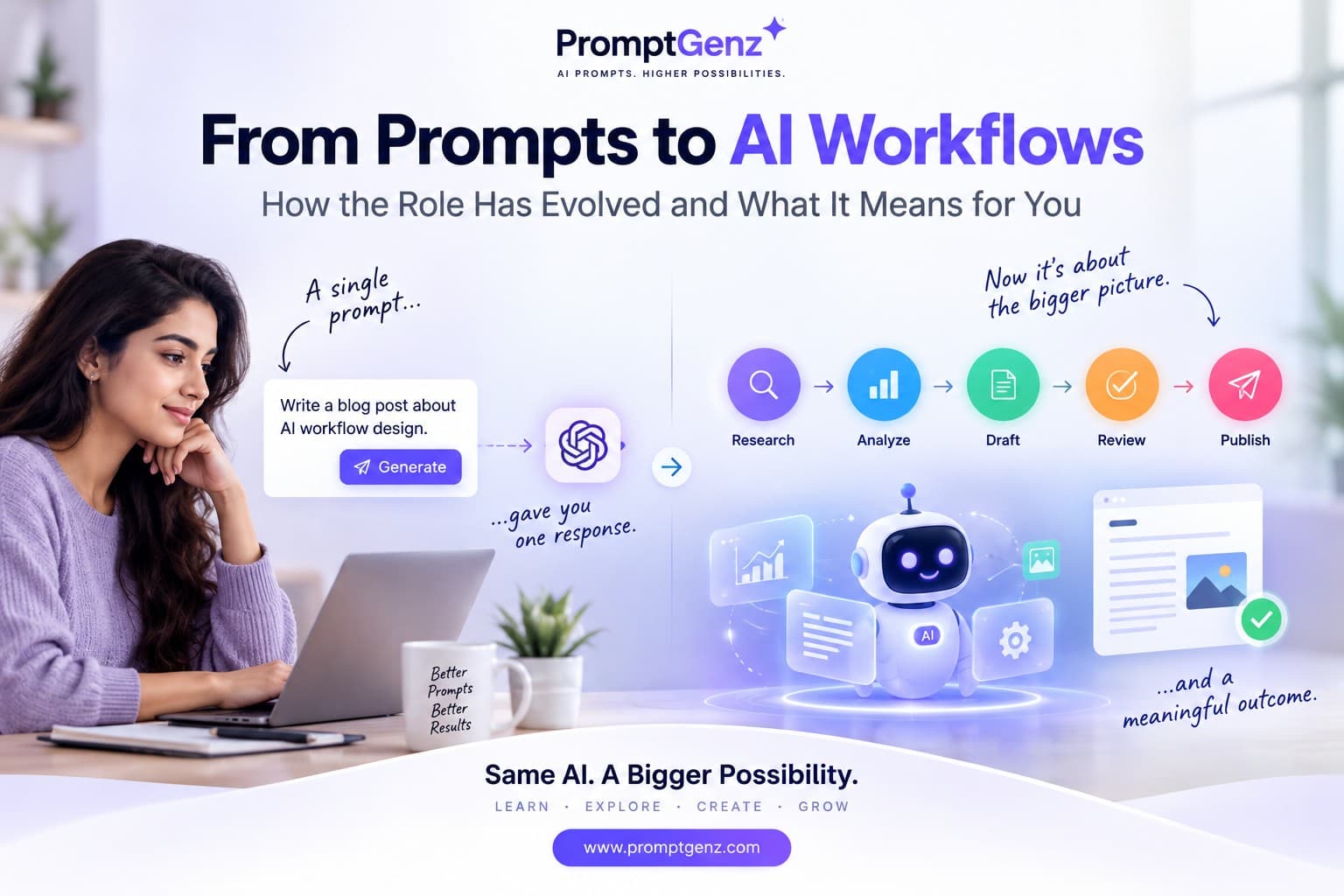
A few years ago, being good at AI often came down to one thing: knowing how to ask the right question. People experimented with prompt formulas, learned which words produced better results, and built libraries of instructions they could reuse. That skill still matters, but the work around it has changed.
Today, getting a useful result from AI is often less about writing one perfect prompt and more about designing what happens around it. Where does the information come from? Which tools does the AI need? How should the result be checked? What happens when the first answer is wrong? And where should a person step in?
That is the shift behind the growing interest in AI workflows and agentic systems. Prompting has become one part of a larger skill: designing a reliable process in which AI can reason, use information and tools, produce work, and hand important decisions back to people.
The Job That Used to Be
When generative AI first became part of everyday work, a lot of the focus was on getting better answers from the model. People learned how to structure instructions, provide examples, specify a tone, define a role, and give the model enough context to produce a useful response. In many cases, the prompt itself was the main thing being designed.
That made prompt engineering an important skill. A well-written prompt could turn a vague request into a much more useful result, and teams started collecting reusable prompts for writing, research, analysis, customer support, coding, and other tasks.
But as AI systems became more capable, the limitation was no longer always the wording of the prompt. A good prompt can still produce a poor result if the model does not have the right information, cannot access the necessary tools, has no way to verify its output, or is being asked to complete a task that requires several connected steps.
That is where the nature of the work starts to change. The question is no longer only, "What should I tell the AI?" It increasingly becomes, "What should the AI do, what does it need to do it, and how do I know the result is good enough?"
What Changed: From Prompts to Systems
The biggest change is that AI is no longer being used only as a place to send instructions and receive an answer. Increasingly, it is being placed inside a larger process. The AI might retrieve information, work with files, call a tool, transform data, produce a draft, check its own output, or pass the result to another step.
That changes what a good AI practitioner needs to think about. Instead of focusing only on the wording of a prompt, you start thinking about the entire path from input to outcome. What triggers the workflow? What context should the AI receive? Which tools should it be able to use? What should happen if something goes wrong? Which parts should remain under human control?
From One Prompt to a Complete Workflow
This does not make prompt engineering irrelevant. The prompt is still an important part of the system. The difference is that it is now one component inside a larger design. A strong instruction can improve an individual step, but a well-designed workflow determines whether all the steps work together.
This is also where the idea of AI agents becomes important. A traditional workflow usually follows a predefined sequence, while an agent can have more freedom to decide which actions or tools to use based on the task. In both cases, the underlying goal is similar: move beyond a single response and use AI to accomplish a meaningful piece of work.
Then vs. Now: What Actually Changed
The easiest way to understand the shift is to compare what the work looked like when prompting was the main focus with what people increasingly need to think about today.
The important difference is not that people stopped writing prompts. They did not. The difference is the size of the problem they are being asked to solve. Instead of optimizing one interaction, the focus is increasingly on making an entire AI-assisted process useful, reliable, and repeatable.
That also means the definition of a successful AI workflow is broader than simply getting a good-looking answer. A workflow has to produce the right outcome, handle the information it depends on, recover from predictable problems, and make it clear when human judgment is still required.
New Habits That Come With the Territory
Once you start thinking about AI as part of a workflow, your day-to-day approach changes too. You spend less time asking, "How can I make this prompt better?" and more time asking, "What does this process need in order to work reliably?"
One of the biggest habits is learning to think in inputs and outputs. Before asking an AI system to do something, you need to understand what information it has, what information it is missing, and what a useful result should actually look like. This sounds simple, but it changes how you design the entire interaction.
Another habit is breaking larger tasks into smaller steps. Instead of expecting one prompt to handle research, analysis, writing, fact-checking, and formatting all at once, you can separate those responsibilities. Each step becomes easier to understand, test, improve, and replace when necessary.
You also start thinking more seriously about context. The model may need documents, structured data, previous outputs, company knowledge, or information from another system. Giving the AI more context is not automatically better; the goal is to provide the right context at the right step.
Then comes evaluation. If an AI workflow is going to be used repeatedly, you cannot rely on the feeling that the output "looks good." You need some way to check whether the result meets the expected criteria. That might mean predefined checks, example outputs, automated tests, human review, or a combination of them.
Finally, you start designing for failure. What happens if the AI gives an incomplete answer? What if a tool fails? What if the information it retrieves is outdated or irrelevant? A useful workflow does not assume everything will go perfectly. It gives you a way to detect problems and decide what should happen next.
The mindset shift is simple: don't just optimize the AI response. Design the process around the response.
Does This Mean You Need to Learn to Code?
Not necessarily. You do not need to become a software engineer just because AI work is becoming more workflow-oriented. But having some technical understanding can make a big difference in what you are able to build and improve.
For example, it helps to understand how APIs work, how data moves between systems, how files and structured data are handled, and how different AI tools can be connected. You do not need to write a large application from scratch, but knowing what is possible makes it easier to design a better workflow.
This is where basic coding can become useful. A small script might transform data before sending it to a model. An API call might bring information from another system. A simple condition might decide whether an AI-generated result needs another review step. These are not necessarily complicated programming problems, but they can remove a lot of manual work.
The more important skill is knowing when code is actually needed. Good workflow design does not mean adding technology everywhere. Sometimes a well-structured prompt and a human review step are enough. In other cases, connecting a few tools or automating repetitive steps can make the workflow much more valuable.
So the goal is not to turn every prompt engineer into a full-time developer. It is to become technically comfortable enough to understand the building blocks around AI and make sensible decisions about when to use prompts, tools, data, automation, or human judgment.
What This Looks Like in a Normal Job
You do not need to work for an AI company to use these skills. In fact, some of the most useful AI workflows are being built around ordinary business processes that people already perform every day.
Imagine someone working in customer support. Instead of using AI only to write a reply, they could build a workflow that gathers the customer's history, retrieves the relevant product information, drafts a response, checks it against support guidelines, and sends it to a person for approval before anything goes out.
The same thinking can apply to marketing. AI could help collect information about a campaign, analyze performance data, create a first draft of new content, and prepare variations for review. The person is still responsible for the final decision, but AI handles more of the repetitive work between those decisions.
Finance, operations, sales, HR, legal, and other teams can approach problems in a similar way. The workflow will look different in each department, but the underlying questions stay surprisingly consistent: What information is needed? What should AI handle? Which tools should it access? How should the result be checked? And where does human approval belong?
This is why the shift is bigger than a change in job titles. Someone who understands both a business process and the capabilities of AI can often spot opportunities that a purely technical or purely prompt-focused approach might miss.
The valuable skill is becoming the ability to look at a real piece of work and recognize where AI can safely take over a step, where it can assist a person, and where it should stay out of the decision entirely.
How to Actually Make the Transition
The good news is that you do not have to throw away everything you learned about prompt engineering. The skills still carry over. The transition is more about expanding what you can do with them.
Start by taking a task you already know how to solve with a prompt and look at the process around it. Ask yourself what happens before the prompt, what information the model needs, what happens after it produces an answer, and where mistakes are likely to occur.
Then try turning that process into a small workflow. Connect the relevant information, separate the task into logical steps, and define what a good result looks like. You can start with a simple workflow before introducing more advanced automation or agentic behavior.
The next step is learning how to work with the building blocks around AI. Get comfortable with concepts such as APIs, structured data, retrieval, tool calling, workflow automation, and evaluation. You do not need to master all of them at once. Learn enough to understand what each piece is useful for and when it belongs in a workflow.
Most importantly, practice on real problems rather than building workflows just because the technology is available. Take a repetitive task from your own work and ask whether AI can genuinely make the process faster, better, or easier to scale. If it cannot, leaving the process alone may be the better engineering decision.
Over time, this changes the way you think about AI. You stop measuring your skill only by how well you can write prompts and start measuring it by whether you can design a process that consistently turns AI capabilities into useful outcomes.
The Takeaway
Prompt engineering is not disappearing. What is changing is the scope of the work around it. Writing a strong prompt is still useful, but it is increasingly one part of a much larger process.
The valuable skill is becoming the ability to design how AI fits into real work: giving it the right context, connecting the right tools and information, breaking complex tasks into manageable steps, evaluating the results, and knowing when a person needs to take over.
That does not mean everyone needs to become a developer or build complex AI agents. It means learning to think beyond the prompt. The people who can understand a real problem, design a sensible AI-assisted workflow, and improve it based on what actually happens will have a much broader skill set than someone who only knows how to write clever instructions.
So if you started with prompt engineering, there is no need to think of that experience as outdated. Think of it as the foundation. The next step is learning how to turn individual AI interactions into reliable processes that help people get meaningful work done.
The future is not prompt engineering versus AI workflows. It is prompt engineering becoming one part of better AI-powered work.