Prompt Engineering Skills That Actually Matter in 2026 (And Which Habits Need Updating)
Prompt engineering is evolving as AI models become better at reasoning, following instructions, and handling context. Learn which prompting skills still matter in 2026 and which older habits are worth updating.
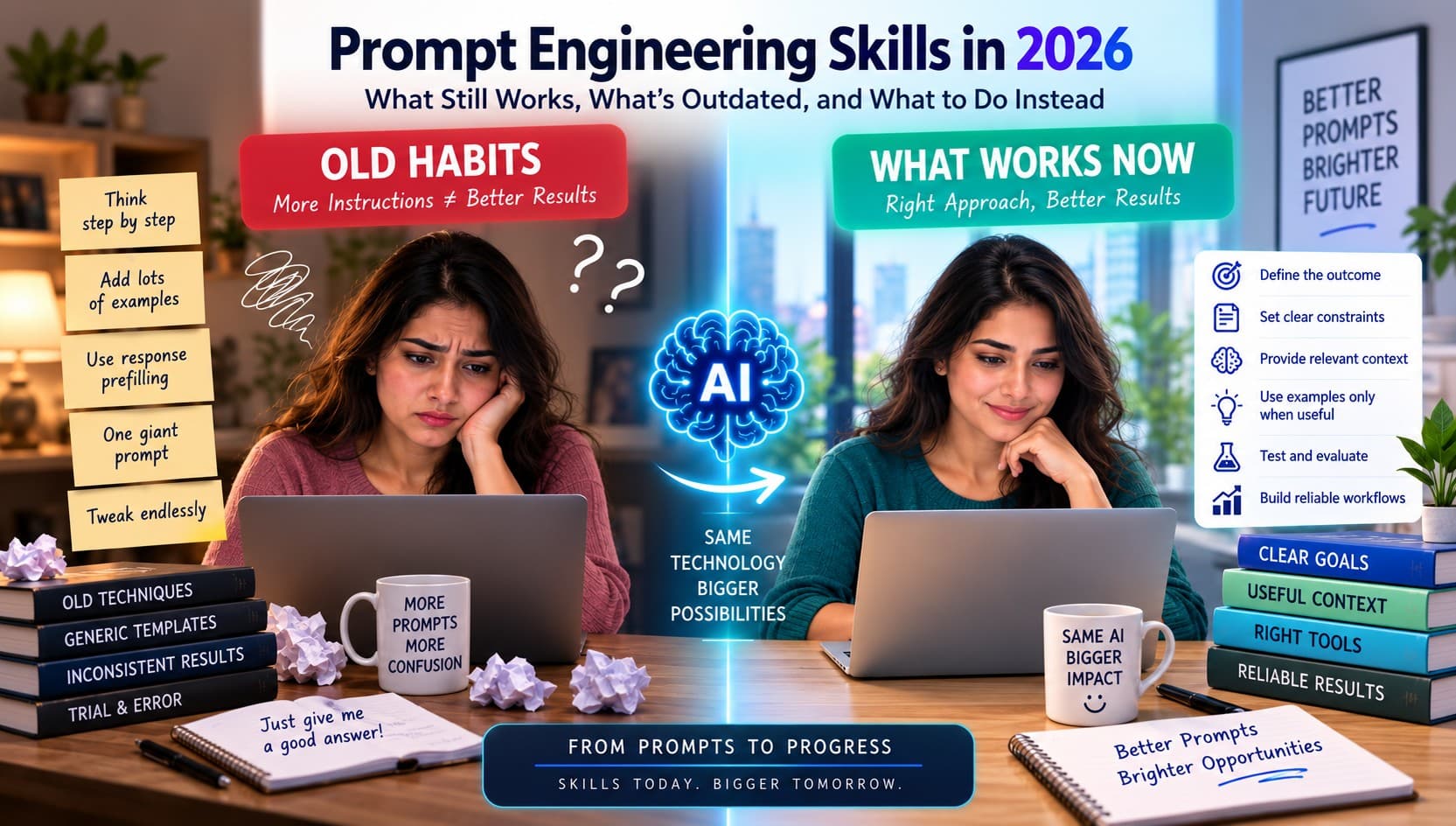
If you learned prompt engineering a couple of years ago and haven't updated your habits since, some of what you're doing may be working harder than it needs to.
That's not because those techniques were bad. Many of them were genuinely useful for earlier generations of AI models. But AI models have become better at following instructions, reasoning through complex tasks, and working with larger amounts of context.
The result is a subtle shift: some prompting habits are still useful in the right situation, while others have become unnecessary defaults. The skill is becoming less about collecting clever prompting tricks and more about knowing which technique to use, when to use it, and when to leave it out.
The good news is that prompt engineering isn't going away. It's becoming more practical and more closely connected to context, evaluation, tools, and workflow design.
In this article, we'll look at the prompting skills that still matter in 2026, the habits that are worth updating, and how to think about prompting differently as AI systems become more capable.
Why This Even Needs Sorting Out
A lot of the confusion comes from how quickly AI models have changed. Prompting techniques that were genuinely helpful with earlier models can still show up in tutorials, courses, and prompt libraries today, even when newer models no longer need the same level of instruction.
Earlier models often benefited from very explicit instructions about how to approach a problem. Today, many reasoning-capable models can handle much of that work internally. That means a prompt that carefully dictates every step isn't automatically better.
The important distinction is this: newer models don't mean you should stop giving clear instructions. They mean you should be more selective about which instructions actually help.
Instead of automatically telling the model exactly how to reason, start by describing the outcome you need, the important constraints, the available context, and what a successful answer should look like.
That shift explains many of the prompting habits we'll look at below. Some techniques still have a place when the task calls for them. The real skill in 2026 is knowing when a technique is useful instead of treating it as a rule for every prompt.
Still Solid: The Fundamentals That Haven't Moved
Some things haven't changed because they were never really about exploiting weaknesses in a model. They were about communicating clearly.
The tools and models may keep changing, but a few core prompting habits continue to make AI interactions more useful and predictable.
1. Clarity over cleverness.
A plainly stated, specific instruction still beats a vague request dressed up in clever wording. If you wouldn't give the instruction to a new employee and expect them to understand the task, the model probably won't either.
2. Task decomposition.
Breaking a large, messy task into smaller, well-defined steps is still valuable for complex work. It makes the task easier to understand, test, debug, and improve.
The important part is knowing when to decompose. Simple tasks don't always need a complicated chain of prompts.
3. Structured outputs.
Asking for a specific output format — a table, JSON object, numbered list, or defined set of fields — remains extremely useful, especially when the result needs to move into another tool or workflow.
4. Prompt chaining when the task benefits from it.
For complex, multi-stage work, connecting several focused prompts can be easier to manage than putting every requirement into one enormous instruction.
But chaining shouldn't become a rule either. If one well-designed prompt can solve the task reliably, adding more steps only creates more complexity.
5. Iterating based on evaluation, not vibes.
A prompt that worked once isn't necessarily a good prompt.
Test it with different inputs, edge cases, and realistic examples. Look at what fails, adjust the prompt or workflow, and test again.
That is a much more useful habit than endlessly rewriting a prompt because one response didn't feel quite right.
Outdated as a Default: Habits That Need Updating
The interesting part isn't that these techniques have completely disappeared. It's that they shouldn't automatically be your first move anymore.
1. Automatically telling reasoning models to "think step by step."
This is probably the biggest habit worth reconsidering.
Many modern reasoning models can work through complex problems without you having to prescribe every step of their reasoning. A better starting point is often to explain the outcome you need, the important constraints, the available context, and what a successful answer should look like.
If the task genuinely requires a specific procedure, then describing that procedure still makes sense.
The lesson isn't "never ask for step-by-step reasoning." It's: don't prescribe the model's reasoning process unless the task actually requires it.
2. Adding lots of examples by default.
Few-shot examples are still useful. The problem is adding them automatically.
Start with a clear zero-shot instruction. If the model consistently misses a particular format, tone, classification boundary, or edge case, add a small number of strong examples.
Good examples should teach something useful. More examples are not automatically better.
3. Using response prefilling as a universal workaround.
Prefilling or forcing the beginning of a response can still be useful in some model-specific situations, but it shouldn't be your default method for controlling output.
Modern models generally give you better ways to specify the desired format, constraints, and outcome. Use prefilling when you have a clear reason for it, not simply because an older model needed the nudge.
4. Micromanaging reasoning settings for every task.
Modern models increasingly expose controls for reasoning effort, but that doesn't mean you need to tune them manually for every individual request.
Think about the workload instead. A simple classification task may need little reasoning. A complex coding, research, or planning task may benefit from more.
The useful skill is understanding the trade-off between quality, latency, and cost — not endlessly tweaking a setting because it exists.
How Prompting Habits Are Changing
The Real Split: Casual Prompting vs. Production Prompting
This is probably the most useful mental model to take away from the article.
Getting a good answer from a modern AI tool can be surprisingly easy. But building something that runs repeatedly, handles different inputs, and produces reliable results without someone checking every response is a completely different challenge.
If you're only using AI casually, you don't need to over-engineer every prompt. A clear instruction and a quick review may be all you need.
But if you're building reusable templates, automations, customer-facing systems, or AI-powered workflows, prompting becomes only one part of the engineering problem.
That's the distinction worth remembering. Casual prompting is mainly about getting useful results from an interaction. Production prompting is about creating behavior that remains useful and reliable when the same process is used again and again.
One More Shift Worth Knowing: Prompt Engineering vs. Context Engineering
A related idea that has gained real traction is context engineering.
Prompt engineering focuses on designing the instructions given to a model. Context engineering looks at the bigger picture: what information should actually be available to the model at the moment it needs to act?
That can include retrieved information, conversation history, memory, tool definitions, external data, previous outputs, and other pieces of context that help the model understand the task.
Think of it this way. Prompt engineering asks, "How should I word this instruction?" Context engineering asks, "What information does the model need in front of it to do this well?"
This distinction becomes especially important when AI is used inside larger workflows. A model may have a perfectly written instruction, but if it receives incomplete, irrelevant, or outdated information, the final result can still be poor.
You don't need to become a context-engineering specialist to write good prompts. But if you're moving toward AI workflows and agentic systems, understanding context becomes increasingly important because the model is no longer operating from one isolated prompt.
The progression is worth remembering: prompt engineering helps shape the instruction, context engineering helps shape the information available to the model, and workflow or agent design determines how those pieces work together to accomplish a larger task.
A Quick Self-Check
If you want a fast way to audit your own prompting habits, ask yourself these questions.
- Am I automatically adding "think step by step" even when the model doesn't need a prescribed process? Try an outcome-first prompt instead.
- Am I adding examples simply because I think more examples must be better? Try zero-shot first, then add only the examples that solve a real problem.
- Am I writing one giant prompt when the task naturally contains several independent stages? Try breaking it into smaller steps and compare the results.
- Do I actually know whether my prompt works across different inputs, or did it just work once? Test it against realistic and messy examples.
- Am I focusing only on the wording of the prompt when the real problem is missing context, tools, data, or evaluation? Look at the entire workflow.
If you find yourself answering "yes" to several of these, you probably don't need to learn more prompting tricks. You may simply need to update how you think about prompting.
The goal isn't to make every prompt shorter, longer, simpler, or more sophisticated. The goal is to understand what the task actually needs and use the right technique for that situation.
The Takeaway
Prompt engineering isn't becoming irrelevant. It's becoming less about collecting clever tricks and more about making deliberate decisions.
The fundamentals still matter: clarity, useful context, appropriate structure, decomposition when necessary, and testing your results.
What is changing is the role of the prompt itself.
With more capable models, you often don't need to micromanage every step of the process. Instead, you need to be better at defining the outcome, supplying the right context, choosing when examples are actually useful, and evaluating whether the result works reliably.
And when AI becomes part of a larger workflow, the question gets bigger than: "What's the perfect prompt?"
It becomes: "What does the AI need to accomplish this task reliably?"
That's the mindset shift that matters most in 2026.
Pick one prompt you use regularly and try this: remove unnecessary instructions, clarify the desired outcome, define the important constraints, and test the result against several realistic inputs.
You may find that the best prompt isn't the longest one. It's the one that gives the model exactly what it needs — and lets it do the rest.