What Are AI Agents, Really? A Plain-English Guide for Non-Developers
Confused about AI agents? Learn in plain English what AI agents are, how they differ from chatbots and automation, how they work, where they are already being used, and when it makes sense to use one.
You've probably seen the word "agent" everywhere lately. Every app update, every AI newsletter, every LinkedIn post seems to be talking about "AI agents" like everyone already knows what they are. If you've quietly nodded along while wondering what the difference actually is between an AI agent and a regular chatbot, you're not alone — and you don't need to be a developer to understand it.
The confusing part is that AI assistants are getting more capable all the time. Some can now browse the web, work with files, use connected tools, and complete parts of a task for you. So the difference isn't simply that a chatbot talks while an agent acts. The more useful question is how much of the task the AI can figure out and carry out on your behalf.
This guide breaks it down in plain English, with everyday examples, so you can understand what an AI agent really is, how it differs from a chatbot and traditional automation, how agents work through multi-step tasks, and where you might already be using one without realizing it.
Start With What You Already Know: The Chatbot
Think about how you normally use ChatGPT or Claude. You type a question, the AI responds. You ask a follow-up, it responds again. It's a conversation, and you're usually guiding the interaction one request at a time.
That's a really useful pattern for writing, brainstorming, getting explanations, analyzing information, or working through an idea. Modern AI assistants can also go beyond simple conversation by using features such as web search, file analysis, or connected tools.
So the difference isn't simply that a chatbot can only talk while an agent can act. The more useful distinction is how the task is handled. In a typical chat interaction, you're still directing the conversation and deciding what should happen next. An agent is designed to take a broader goal, determine the steps needed, use the tools available to it, and continue working toward the outcome with less step-by-step direction from you.
Think of it this way: with a chatbot, you're usually having a conversation with the AI about the work. With an agent, you're increasingly handing the AI a piece of the work itself.
So What's an AI Agent, Then?
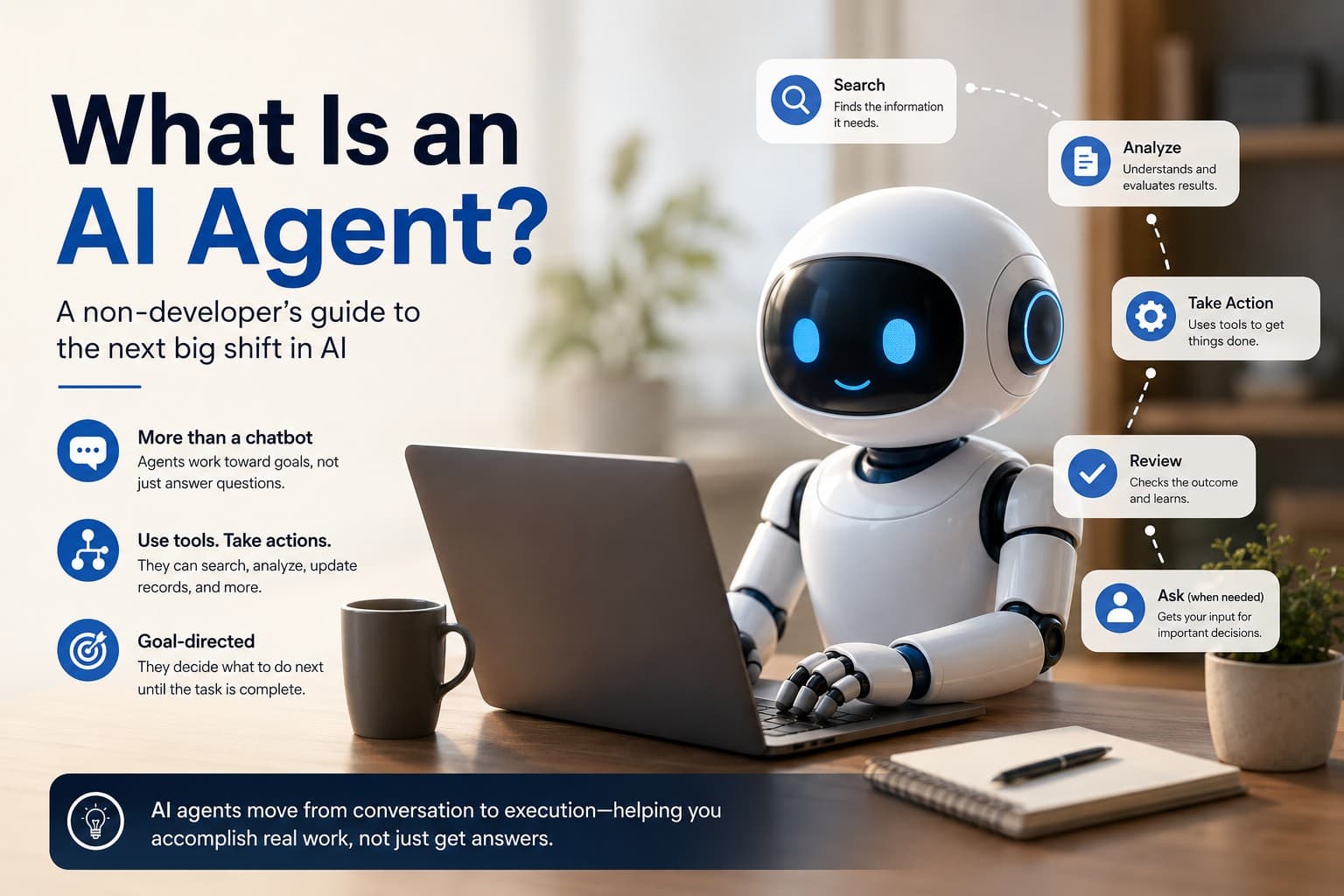
An AI agent is an AI system designed to work toward a goal with a degree of independence. Instead of needing you to spell out every step, the agent can decide what needs to happen next, use the tools available to it, check the results, and continue working until the task is complete, it reaches a limit, or it needs your input.
A chatbot mainly responds to your instructions. An agent is given a goal and can work through the steps needed to achieve it.
Think of it like the difference between asking a smart friend for advice and handing a task to a capable personal assistant. Your friend might tell you what you should do. A personal assistant can figure out the steps, use the resources available to them, do the work, and come back when the task is finished or when they need your decision.
That's what makes an agent feel different. You don't necessarily have to say, "Now do this. Now check that. Now open this tool." You give it the outcome you're trying to achieve, and the system can determine more of the path between the starting point and the result.
Of course, an agent isn't an independent digital employee that can safely do anything you ask. Its capabilities depend on the model behind it, the tools it can access, the permissions it has, the instructions it follows, and the safeguards around it.
AI Agent vs Chatbot vs Automation
These terms are often used as if they mean the same thing, but they don't. The easiest way to tell them apart is to look at who decides what happens next.
- **Chatbot** — you ask a question or give an instruction, and the AI generates a response. You usually guide the conversation from one request to the next.
- **Traditional automation** — predefined rules determine what happens. For example, "When a new form is submitted, send an email and add the information to a spreadsheet."
- **AI workflow** — AI can handle one or more steps inside a predefined process, but the overall sequence is still largely designed in advance.
- **AI agent** — you give the system a goal, and it can decide more of the steps needed to reach that goal, use available tools, observe the results, and adjust its approach when necessary.
The boundaries aren't always perfectly clean. A single product can combine chat, automation, workflows, and agentic behavior. That's why the product label isn't always the best guide. Look at what the system can actually decide and do.
Here's a simple way to picture it: automation follows a recipe, a chatbot helps you talk through the recipe, while an agent can be given the goal and figure out more of the cooking process itself using the tools and ingredients it has access to.
That last part is important. An agent isn't defined simply by having access to tools. What makes the workflow more agentic is that the AI has some responsibility for deciding which actions to take and how to proceed toward the goal.
A Real Example to Make This Click
Let's say you're planning a work trip. With a typical chatbot, you might ask it to help compare flights, hotels, and schedules. It can help you think through the options and, if it has access to the right tools, it may even search current information for you. But you're still generally directing the conversation and deciding what should happen next.
Now imagine an agent that has access to approved travel and calendar tools. Instead of asking it one question at a time, you could give it a goal such as: "Find the best direct morning flight for my work trip, compare the options against my preferences, and prepare the selected itinerary for my approval."
The agent could then:
- Search available flight options using its connected tools.
- Compare the results against the preferences you provided.
- Identify the option that best matches your requirements.
- Prepare the itinerary and relevant calendar details.
- Return the recommendation and ask for approval before taking a consequential action such as purchasing the ticket.
If the agent has the appropriate booking integration and permission to complete the purchase, it could potentially handle that final step too. But that's a capability of the particular system, not something every AI agent can automatically do.
That's the important difference. The agent isn't simply answering a series of questions about your trip. It's working through a multi-step task, deciding what to do next, using tools to gather information, and moving toward a defined outcome.
You've Probably Already Used One
AI agents can sound futuristic, but agentic features are already showing up in tools people use for coding, research, customer support, and everyday work. You may have interacted with one without thinking of it as an "agent."
- **Coding agents** — coding-focused agents can work with a codebase, inspect files, write or modify code, run tests, investigate failures, and prepare changes for review. Google's Jules, for example, is designed to handle asynchronous coding tasks rather than simply answer programming questions.
- **Research agents** — instead of asking you to search for every source yourself, an agent can break a research goal into smaller tasks, search available sources, gather relevant information, compare findings, and produce a structured result.
- **Customer-support agents** — an agent can look up information from approved systems, work through troubleshooting or support steps, update records, and escalate the conversation when the situation requires human judgment.
- **Workplace agents** — agents can work across connected business tools to gather information, prepare reports, update records, coordinate routine tasks, or move information between systems when they have the appropriate access.
The important word here is "can." Not every coding assistant, research tool, or customer-support system is an AI agent. Some are simply AI features inside a larger workflow. Look at what the system actually does rather than relying on the product's marketing label.
You also don't need to be a developer to use an agent. From a user's perspective, the experience may be as simple as describing the outcome you want, providing the necessary context, and letting the system handle the steps it is capable and authorized to perform.
Why This Matters for Your Day-to-Day Work
You don't need to build an AI agent to benefit from understanding them. The useful skill is knowing when a task is better handled by a conversation, a traditional automation, or a system that can work through multiple steps on its own.
For many everyday tasks, a chatbot or AI assistant is already enough. If you mainly need information, ideas, writing help, or analysis, there's little reason to introduce a more autonomous system.
**Good chatbot or AI-assistant tasks:**
- Drafting an email
- Brainstorming ideas
- Explaining a difficult concept
- Summarizing a document
- Rewriting or improving text
- Analyzing information and discussing the results
Agents become more interesting when the task involves several steps, multiple tools, changing information, or a clear outcome that you don't want to manage manually from beginning to end.
**Good agent-style tasks:**
- Researching several competitors and compiling a comparison
- Gathering information from multiple approved systems and preparing a report
- Monitoring information sources and flagging meaningful changes
- Working through a multi-step customer-support investigation
- Coordinating routine work across connected business applications
Here's a useful rule of thumb: if you repeatedly take the AI's output, put it into another tool, check the result, and then tell the AI what to do next, there may be an opportunity to automate more of that process or use an agent to coordinate the steps.
That doesn't mean an agent is automatically the better choice. If a task is simple, predictable, and easy to describe with fixed rules, traditional automation may be cheaper, faster, and easier to control. The value of an agent comes from handling situations where some flexibility and decision-making are actually useful.
A Word of Caution: Agents Aren't Magic
It's easy to get carried away when you see an agent complete a complicated task. But an agent isn't an independent digital employee that can safely handle anything you give it. It can misunderstand instructions, make incorrect assumptions, use the wrong information, or take an action you didn't expect.
The more tools and permissions an agent has, the more important its boundaries become. A system that can only summarize information has a very different risk profile from one that can send emails, change records, purchase something, or make changes inside a business system.
A few principles are worth keeping in mind:
- **Keep high-impact actions behind approval.** Payments, purchases, important communications, account changes, and other difficult-to-reverse actions may deserve a human confirmation step.
- **Give the agent only the access it needs.** Avoid giving an agent broad permissions when a narrower set of tools or data is enough for the task.
- **Expect mistakes.** An agent can produce a plausible but incorrect result, misunderstand a situation, or choose an unsuitable next step.
- **Be careful with information the agent encounters.** Web pages, documents, emails, and other external content can contain instructions that attempt to influence an agent's behavior.
- **Define when the agent should stop.** A good system should have clear boundaries and a way to hand control back to a person when the task is uncertain, sensitive, or outside its authority.
The goal isn't to give an agent maximum freedom. It's to give it enough autonomy to be useful while keeping important decisions, permissions, and consequences under appropriate control.
In other words, don't ask only, "What can this agent do?" Also ask, "What can it access, what can it change, and what happens if it gets something wrong?"
Where This Is Heading
AI agents are moving from interesting experiments toward real workplace tools. The bigger shift isn't simply that AI can answer better questions. It's that people are increasingly giving AI larger pieces of work to complete.
In 2026, this shift is becoming visible across more than software development. Agents are being used for research, reporting, customer support, business operations, and other knowledge-work tasks. OpenAI's recent enterprise data, for example, describes a move from AI assistance toward delegated execution, with agents increasingly connected to company context, tools, and repeatable workflows.
That doesn't mean every job is about to become a collection of autonomous AI workers. A more realistic direction is collaboration: people define goals, provide context, make important decisions, and review outcomes while agents handle parts of the execution.
The technology is also moving beyond simple one-off tasks. Agents can increasingly work on longer-running problems, use multiple tools, and continue through several steps without requiring a person to provide a new instruction after every action.
But greater capability also makes good boundaries more important. Organizations adopting agents need to think about permissions, security, evaluation, monitoring, data access, and the points where a human should approve or take over.
So the interesting question isn't simply, "Will AI agents become common?" It's "Which parts of our work are actually better when we delegate them to an agent, and where should humans remain firmly in control?"
The Takeaway
An AI agent isn't simply a chatbot with a fancier name. It's a system designed to work toward a goal with some degree of independence — deciding what steps to take, using available tools, checking what happens, and continuing or adjusting until it reaches the goal or needs human input.
The important part isn't how autonomous an agent sounds. It's what it can actually do, which tools and information it can access, what permissions it has, and where a person remains in control.
You don't need to understand the technology behind an agent to recognize one. The next time an AI moves beyond answering your question and starts working through a multi-step task on your behalf, you'll know what you're looking at.
And that may be the most useful way to think about the whole topic: AI is moving from helping us produce individual answers toward helping us accomplish larger pieces of work.